Resleeve.
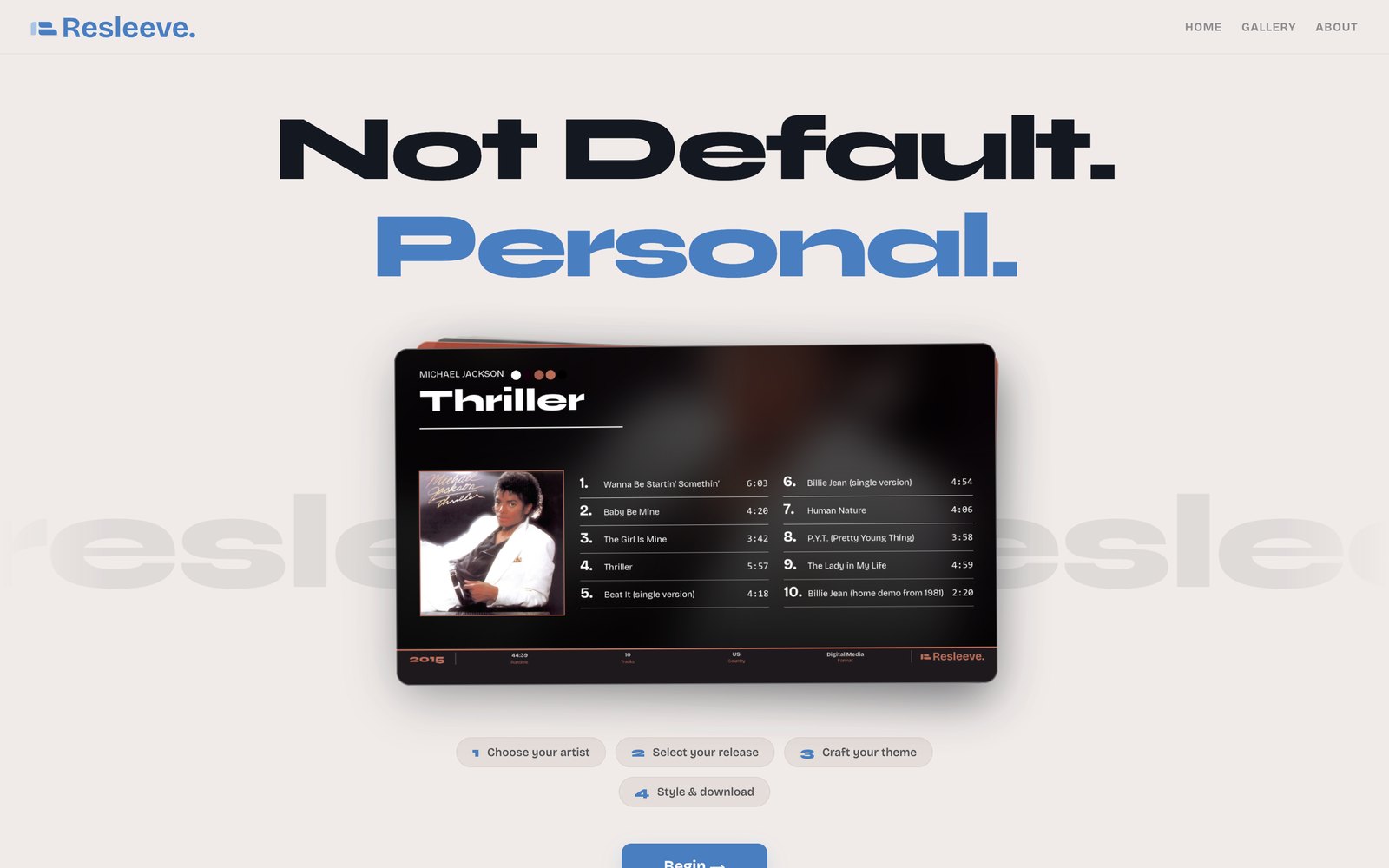
A Python web app that turns any music release into a high-resolution poster-style wallpaper, with artwork, tracklist and runtime composed server-side with Pillow.
Project summary
Resleeve started as a simple idea: make clean, personal album wallpapers without hunting for fan art or designing each one by hand. The product grew into a multi-step Flask app with MusicBrainz search, custom visual settings, palette-aware themes and full-resolution server-side rendering.
Problem being solved
Music fans often want high-quality visuals for albums and singles, but available images are usually low resolution, generic, watermarked or disconnected from the release metadata. Resleeve combines authoritative release data with user-controlled design choices and produces a finished wallpaper in one flow.
Target users
The primary users are music fans, playlist curators and people who want personal desktop or mobile backgrounds based on specific releases. The interface is built for non-technical users: search, select, style, preview and download.
Architecture overview
The Flask backend handles search and rendering. Music metadata comes from MusicBrainz and cover art is retrieved through the Cover Art Archive. Pillow composes the output image on the server, applying adaptive layout rules for albums, EPs and singles. The frontend is a vanilla HTML, CSS and JavaScript wizard with no framework dependency.
Important technical decisions
I kept rendering server-side because it gives predictable typography, image quality and export dimensions. I avoided a frontend framework to keep the interface fast and controlled. Layout templates are separate render paths so each design can make its own spatial decisions instead of forcing every output through one generic engine.
Difficult problems and solutions
The hardest part was making layouts survive the variety of real music data: single-track releases, long deluxe albums, missing artwork and wildly different cover palettes. Resleeve handles those with release-type checks, adaptive text sizing, column balancing and contrast-aware colour choices.
Results and lessons learned
Resleeve is live and actively usable. It taught me that image generation products live or die by edge cases: the code can be straightforward, but the judgement encoded into spacing, contrast and fallback behaviour is what makes the output feel finished.
Related writing
Building Resleeve: turning albums into wallpapers and Remastering Resleeve: rebuilding it properly.